

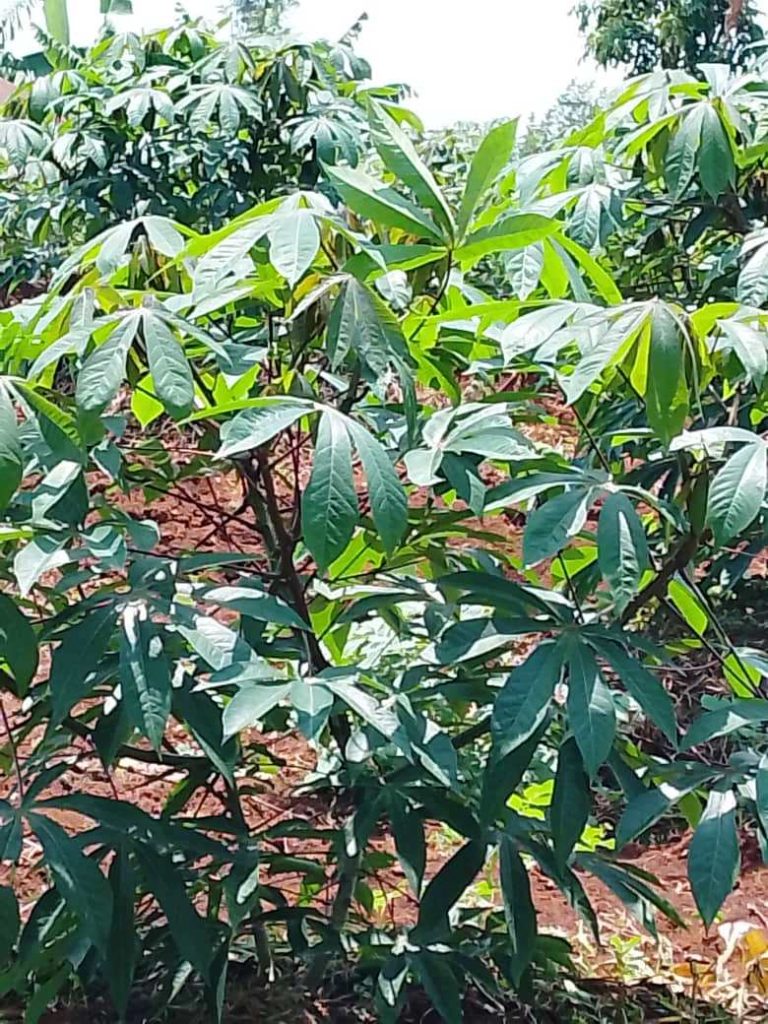
From a demonstration plot to a model for climate-resilient cassava production
In the hills of Byimana Sector, Ruhango District, Southern Province farmer Emmanuel Renzaho is turning his cassava field into more than a place of production. Through SCORE Rwanda Project funded by the Global Agriculture and Food Security Program (GAFSP) and supervised by the International Food and Agricultural Development (IFAD) his farm is becoming a practical learning space where fellow farmers can see, discuss and learn about the potential of Zai Pit technology to improve cassava production and strengthen resilience to climate change.
On Friday, 18 September 2026, INGABO Farmers’ Association visited Mr. Renzaho, a diversified crop farmer and President of IMPAKOMU Cooperative, at his farm in Gihinga Village, Ntenyo Cell, Byimana Sector.
For Mr. Renzaho, the demonstration plot offers an opportunity to move agricultural knowledge beyond theory and into practical application.
“The Zai Pit technique can help farmers retain water in the soil, withstand dry conditions and increase cassava productivity, while also allowing farmers to intercrop cassava with other crops.”— Emmanuel Renzaho, Farmer and President of IMPAKOMU Cooperative
Zai Pit technology: conserving water while improving productivity
During the visit, Mr. Renzaho explained how Zai Pit technology can contribute to climate-resilient farming. By helping retain water in the soil, the technique can support crops during periods of limited rainfall and improve the efficient use of available soil moisture.
He also highlighted the possibility of integrating cassava with other crops through intercropping, allowing farmers to diversify production while making better use of available farmland.
These benefits are particularly relevant as farmers seek practical approaches to cope with changing weather patterns while maintaining and increasing agricultural productivity.
A farmer’s experience points to higher cassava yield potential
Mr. Renzaho sees a significant difference between cassava grown using Zai Pit technology and cassava cultivated under conventional practices.
Based on his observations and experience, he says one cassava plant grown using the Zai Pit technique can potentially produce a yield comparable to that obtained from approximately 20 plants under conventional farming practices.
Drawing on results he has observed in other areas where the technique has been used, Mr. Renzaho expects his cassava plants to produce between 35 and 70 kilograms per plant. He contrasts this with conventional production, where he says a cassava plant generally produced no more than three kilograms.
These figures reflect the farmer’s observations and expectations and underscore the importance of demonstration plots in allowing farmers and agricultural stakeholders to assess improved practices under local farming conditions.
From one farmer’s field to a cooperative-wide commitment
Mr. Renzaho is not keeping his experience to himself. He is actively using his demonstration plot to share knowledge with other farmers and encourage wider adoption of the technology.
Following a community work activity at the end of August 2026, he invited participants to visit his demonstration plot and learn about the benefits of Zai Pit technology.
His next step is to engage members of IMPAKOMU Cooperative. On 23 September 2026, he plans to bring cooperative members to the demonstration plot to learn about the technique, observe its application and discuss how they can adopt it on their own farms.
Mr. Renzaho also intends to encourage cooperative members to include adoption of the technology in their individual performance commitments, with progress to be followed up regularly.
A call for more farmer-led demonstration plots
Looking beyond his own cooperative, Mr. Renzaho believes that more demonstration plots could accelerate the spread of practical agricultural knowledge.
He has called on INGABO Farmers’ Association and its partners to increase the number of demonstration plots in the Districts where INGABO operates, proposing at least three demonstration plots in every village.
He further recommends that cooperatives make the promotion and adoption of improved farming technologies part of their performance commitments.
For INGABO, farmer-led demonstration plots provide an important platform for practical learning, peer-to-peer knowledge sharing and the adoption of improved agricultural practices.
Through the SCORE Rwanda Project, INGABO and its partners continue to support farmers with knowledge, technologies and practical approaches aimed at improving agricultural productivity, strengthening climate resilience and contributing to better livelihoods.
Mr. Renzaho’s field in Byimana is one example of how a farmer’s own experience can become a learning opportunity for an entire community — transforming a demonstration plot into a pathway for wider agricultural change.
“A demonstration plot is not only a place to grow crops; it is a place where farmers can see, learn and make informed decisions about technologies that can improve their production.”
Farmer Emmanuel Renzaho, President of IMPAKOMU Cooperative, explains the benefits of Zai Pit technology on his cassava demonstration plot in Gihinga Village, Byimana Sector, Ruhango District, during a visit by INGABO Farmers’ Association on 18 September 2026.

Leave a Comment (0)