

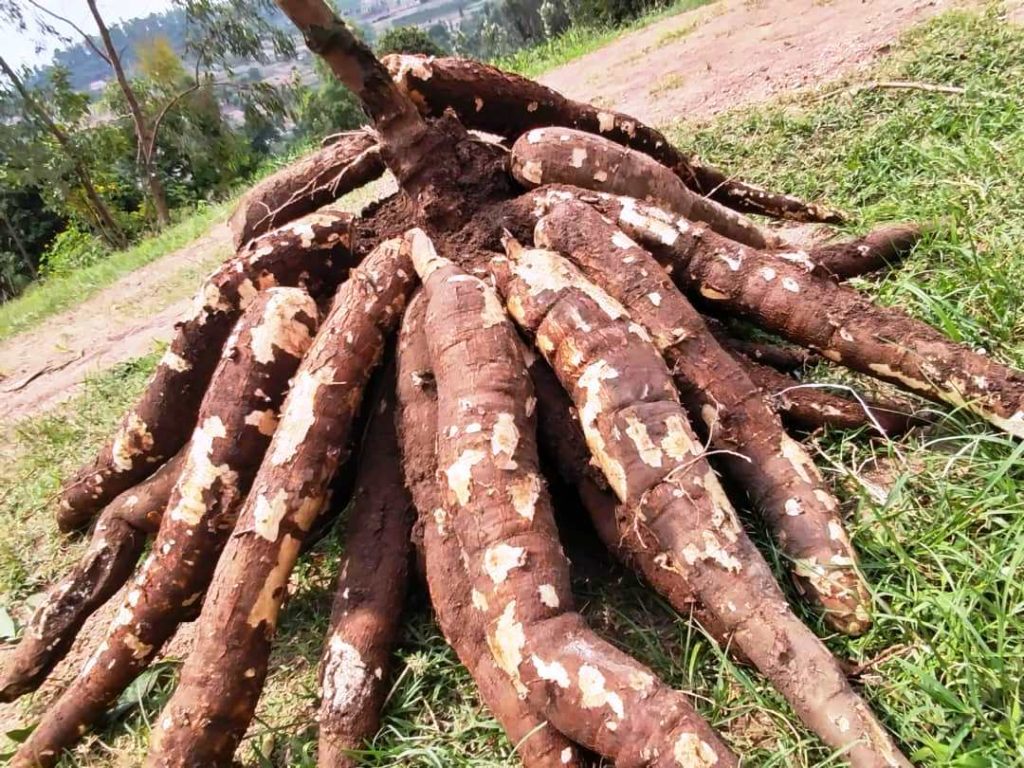
In Ruhango District, through SCORE RWANDA Project funded by the Global Agriculture and Food Security Program and supervised by the International Fund for Agricultura Development (IFAD), farmers are implementing Zai Pit farming alongside conventional practices to see whether the approach can improve cassava productivity and strengthen resilience to climate-related challenges.
Ruhango District, Rwanda — In the fields of Buhoro Village, Nyarutovu Sector, a practical experiment is underway that could provide valuable lessons for cassava farmers: can a simple change in the way cassava is planted help farmers harvest more?
Farmers in the area are testing an innovative approach known as Zai Pit farming, comparing it with conventional cassava production methods. The results expected at harvest will help farmers assess whether the practice can contribute to higher yields while improving the crop’s ability to cope with challenging growing conditions.
Testing the Approach in the Field
Zai Pit farming involves preparing planting pits where organic manure and other essential inputs are placed to improve soil conditions and create a more favourable environment for crop growth. The approach is being tested under local farming conditions, allowing farmers to observe and compare its performance directly in their own fields.
Among those leading the field-level testing is Mukankundire Fortunata, a farmer and lead farmer who has established two plots to compare cassava grown using the Zai Pit method with cassava grown under conventional practices.
For Mukankundire, the most important evidence will come from the harvest.
“The harvest will help us compare the two plots and see which method gives us better results. This will help us understand whether Zai Pit farming can really increase cassava productivity. – Mukankundire Fortunata, Farmer
From Farmer Experiment to Shared Knowledge
Researchers have explained to farmers that Zai Pit farming has the potential to improve yields per cassava plant and help crops cope with periods of water stress and high temperatures. These potential benefits are attracting the attention of farmers who are increasingly interested in practical approaches that can improve productivity while strengthening resilience to climate change.
For Mukankundire, the experiment is not only about her own farm. She plans to share the knowledge and experience gained through farmer learning visits with other farmers, demonstrating how the practice is implemented and encouraging interested farmers to test it under their own conditions.
“What we learn from these plots should not remain with one farmer. I want to share the knowledge with other farmers so that they can also understand how the practice works and test it in their own fields.”
— Mukankundire Fortunata, Farmer
The Harvest Will Tell the Story
The coming harvest will be a critical moment for the farmers. Yield measurements from the Zai Pit and conventional plots will provide practical evidence that can help farmers assess the effectiveness and potential of the approach under local conditions.
Rather than relying only on expectations, farmers will have an opportunity to learn from measurable results in their own fields. The findings could contribute to wider discussions on approaches for increasing cassava productivity and helping farmers respond to changing climatic conditions.
Mukankundire also expressed appreciation to Ingabo Farmers’ Association for its continued support, particularly in helping farmers access improved planting materials, providing technical follow-up, and supporting efforts to connect farmers with markets for their produce.
For the farmers of Buhoro, the Zai Pit experiment is more than a demonstration plot. It is an opportunity to test an idea, measure the results and, most importantly, learn what works best for increasing cassava productivity.
The next harvest may provide the answer.

Leave a Comment (0)