

SCORE Rwanda Strengthens Cassava Productivity and Cooperative Development in Gisagara District, Rwanda
Gisagara, 24 September 2026 — A new chapter is taking shape for cassava farmers in Gisagara District as investments in quality planting materials, improved farming technologies and stronger farmer cooperatives begin to address some of the longstanding challenges affecting cassava productivity.
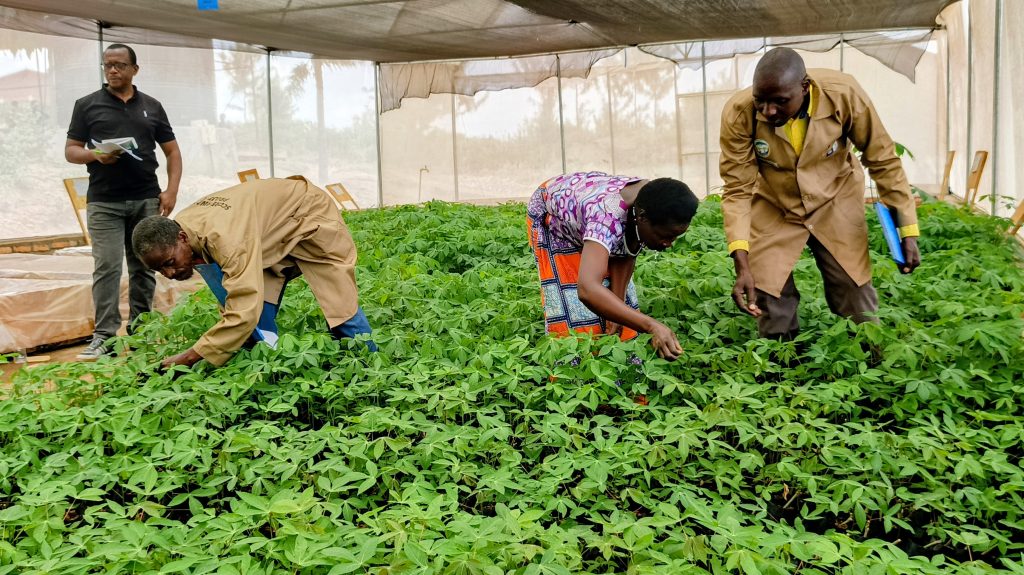
At CATM Cooperative in Mamba Sector, a SCORE Rwanda-supported Screen House is currently holding 10,915 pre-basic cassava planting materials, ready for transfer to a prepared two-hectare field for further multiplication. The development is providing farmers with a more reliable pathway to access quality planting materials while strengthening the cooperative’s capacity to support increased cassava production.
The progress was observed on Thursday, 24 September 2026, when a team from the Ingabo Farmers’ Association visited CATM Cooperative in Karama Village, Mamba Cell, Mamba Sector, Gisagara District, as part of ongoing monitoring of activities implemented under the SCORE Rwanda Project.
Funded by the Global Agriculture and Food Security Program (GAFSP), supervised by the International Fund for Agricultural Development (IFAD) and implemented by Ingabo Farmers’ Association, SCORE Rwanda is supporting agricultural development and farmer organizations across 10 Districts of Rwanda.
10,915 quality cassava planting materials set to expand local seed multiplication
One of the most visible results of the SCORE Rwanda intervention at CATM Cooperative is the establishment of a Screen House dedicated to the multiplication of quality cassava planting materials.
According to CATM Cooperative President Innocent Twagirumukiza, the facility currently contains 10,915 pre-basic cassava planting materials. The materials are expected to be transferred to a prepared two-hectare field, allowing the cooperative to continue multiplying planting materials for future production.
For cassava farmers, access to quality planting materials is critical to improving productivity and strengthening the performance of the crop. The investment in local multiplication therefore represents an important step towards reducing dependence on limited external sources of planting materials.
“We are pleased with the support provided through the SCORE Rwanda Project. The Screen House is an important investment because it will help us address the shortage of quality cassava planting materials and increase production among our members,” said Twagirumukiza.
CATM Cooperative membership grows by nearly 50 percent
The transformation at CATM is not limited to agricultural infrastructure. The cooperative has also recorded significant growth in membership.
CATM currently has 63 members — 36 women and 27 men — including 23 young people. This represents an increase from 43 members recorded during the IFAD Supervision Mission visit in April 2026.
The growth reflects increasing interest among farmers in collective action, cooperative development and access to agricultural opportunities.
The cooperative expects membership to continue increasing as more farmers recognize the benefits of organized production, knowledge sharing and collective investment.
For Ange Musabyimana, one of CATM’s newest members, the cooperative’s governance and working environment were among the key factors that attracted her.
She cited good leadership, transparency, inclusiveness and the cooperative’s continued development as important reasons for joining.
Her experience highlights the role that accountable and inclusive cooperative governance can play in attracting new members, particularly young people, and encouraging greater participation in agricultural development.
SCORE Rwanda promotes Zai Pit technology to increase cassava productivity
Improving access to quality planting materials is only one component of the SCORE Rwanda approach.
The project is also promoting improved agricultural practices, including the Zai Pit technique, to help farmers improve soil and water management and create more favorable conditions for crop production.
Zai Pit is designed to capture and retain water and organic matter around crops, fight erosion, making better use of available moisture and soil nutrients. For smallholder farmers, such practices can contribute to more efficient use of natural resources and support efforts to increase productivity.
At CATM, the promotion of Zai Pit technology complements the investment in quality cassava planting materials, creating an integrated approach that combines improved planting materials with improved production practices.
Ingabo calls for stronger ownership of SCORE Rwanda investments
During the visit, Jean Claude Bizimana, Monitoring and Evaluation Officer at Ingabo Farmers’ Association, commended CATM members for the way they are managing the Screen House and the cassava planting materials.
He urged members to strengthen their sense of ownership and ensure that the facilities and resources provided through SCORE Rwanda and other development partners are properly maintained for the long-term benefit of the cooperative.
Bizimana also encouraged CATM to maintain its commitment to good governance, accountability and transparency, while working towards becoming a model cooperative within its community.
He further called on members to adopt and promote Zai Pit and other improved agricultural practices to support higher cassava productivity and contribute to improved livelihoods.
SCORE Rwanda implements agricultural opportunities across 10 Districts
The progress recorded at CATM Cooperative forms part of the wider work of the SCORE Rwanda Project, implemented by Ingabo Farmers’ Association across Muhanga, Kamonyi, Ruhango, Nyanza, Gisagara, Nyamasheke, Rusizi, Bugesera, Kayonza and Gatsibo districts.
Through support for quality planting materials, improved agricultural technologies, capacity development and stronger farmer organizations, the project is working to strengthen the productivity and resilience of smallholder farming communities.
The experience at CATM demonstrates the potential impact of combining agricultural technology, quality planting materials, cooperative development and farmer ownership.
From a Screen House to a stronger cassava value chain
For CATM Cooperative, the 10,915 pre-basic cassava planting materials represent more than a number. They are an investment in the cooperative’s future and a potential foundation for a stronger local cassava seed system.
Once transferred to the two-hectare multiplication field, the planting materials will provide an opportunity to expand local multiplication and improve access to quality planting materials for farmers.
Combined with the adoption of Zai Pit technology, growing youth participation and strengthened cooperative governance, the intervention is helping CATM move towards a more productive and resilient agricultural model.
The story unfolding in Mamba illustrates how targeted investment in farmer organizations and agricultural productivity can generate change beyond a single cooperative — creating opportunities for farmers, young people and communities while contributing to Rwanda’s broader agricultural transformation.
For SCORE Rwanda and Ingabo Farmers’ Association, the ambition is clear: better planting materials, better farming practices, stronger cooperatives and, ultimately, better livelihoods for smallholder farmers.

Leave a Comment (0)