

Gisagara, 24 September 2026 — Efforts to improve cassava productivity and promote climate-resilient farming practices are gaining momentum in Gisagara District, where farmers are increasingly adopting the Zai Pit technology as part of the SCORE Rwanda Project.
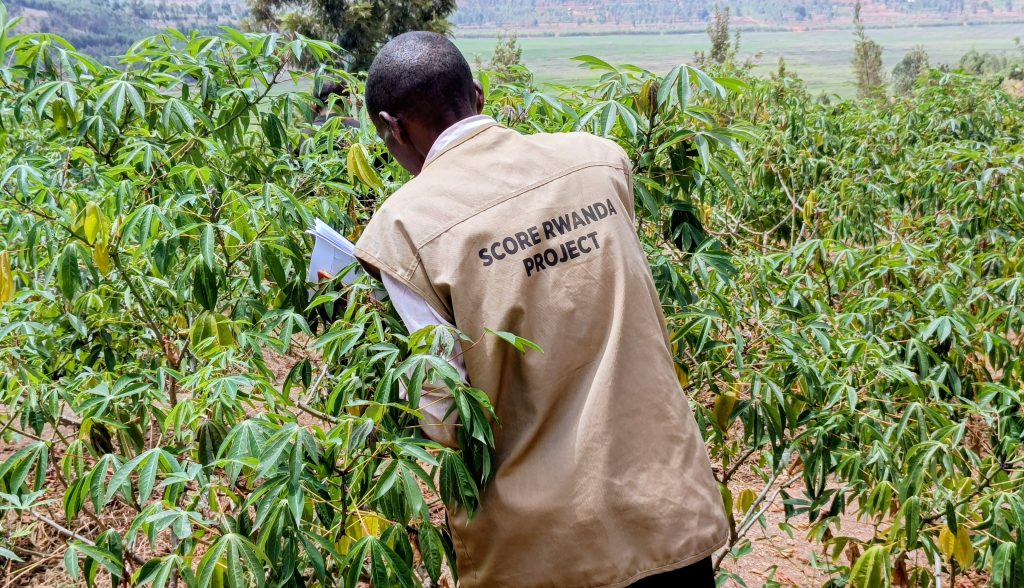
On Thursday, 24 September 2026, a team from the Ingabo Farmers’ Association conducted a field monitoring and information-gathering visit to Rugwiza Village, Gakoma Cell, Mamba Sector, Gisagara District, Southern Province.
The visit focused on a demonstration plot established on the farm of Munyentwali Philimin, a farmer and member of CATM Cooperative, where the team assessed the progress and adoption of Zai Pit technology in cassava production.
Farmers Embrace Zai Pit Technology for Improved Cassava Production
Speaking during the visit, Munyentwali Philimin expressed appreciation to the Ingabo Farmers’ Association and its partners for introducing the SCORE Rwanda Project that has come as blessing to boost cassava productivity in Rwanda and, particularly, in Gisagara District.
He highlighted the Zai Pit technique as a promising approach that could contribute to improved cassava production while helping farmers manage soil and water more effectively.
“We appreciate the support brought through the SCORE Rwanda Project. The Zai Pit technique gives us hope for improved cassava production and better management of our farming land,” said Munyentwali.
According to Munyentwali, the technology is gaining growing interest among CATM Cooperative members. He explained that all cooperative members have included the adoption of Zai Pit in their commitments for the 2027A agricultural season.
Mr. Munyentwali added that more than 100 farmers have already registered to grow cassava using the Zai Pit technique, demonstrating increasing interest in the approach and this number will keep growing as the mobilization continues
Demonstration Plots and Community Outreach Drive Adoption
To promote the technology beyond demonstration plots, farmers and cooperative members are using several community-based approaches to share knowledge and encourage wider adoption.
Munyentwali explained that farmers are promoting Zai Pit through community meetings, Community Works commonly known as Umuganda in the Kinyarwanda language and learning visits to demonstration plots.
These efforts are already generating positive results, with more farmers becoming interested in the technology and an increase in cooperative membership.
The demonstration plot has therefore become an important learning platform where farmers can observe the technique in practice, exchange experiences and understand how it can be applied in their own fields.
Building Climate-Resilient Cassava Farming
For farmers participating in the SCORE Rwanda Project, the benefits of Zai Pit extend beyond cassava production.
Munyentwali highlighted the various trainings provided through the project, particularly on improved cassava production practices, environmental protection, erosion control and climate resilience.
The technology also supports the integration of cassava with other crops, enabling farmers to diversify production while making better use of available land and resources.
Zai Pit technology is designed to help retain water and organic matter around crops, contributing to improved soil and water management and reducing the effects of erosion. These practices can be particularly valuable as farmers seek to strengthen the resilience of their production systems to changing climatic conditions.
Farming for the Market
Beyond increasing production, Munyentwali emphasized that his ambition is to produce cassava for the market, not only for household consumption.
This market-oriented approach reflects the broader objective of strengthening farmers’ productivity and connecting agricultural production with economic opportunities and improved livelihoods.
With more than 100 farmers already expressing interest in adopting Zai Pit for the 2027A agricultural season, the experience at CATM Cooperative demonstrates how farmer-to-farmer learning, practical demonstrations and targeted training can accelerate the adoption of improved agricultural technologies.
SCORE Rwanda Strengthens Farmer-Led Agricultural Transformation
The field visit forms part of ongoing monitoring and documentation of activities implemented under the SCORE Rwanda Project, funded by the Global Agriculture and Food Security Program (GAFSP) and supervised by the International Fund for Agricultural Development (IFAD).
Through the project, Ingabo Farmers’ Association is supporting farmers with improved agricultural technologies, knowledge and capacity development aimed at strengthening productivity, environmental sustainability and climate resilience.
The experience in Mamba demonstrates the potential of combining practical farmer training, demonstration plots, climate-smart technologies and cooperative action to strengthen cassava production.
As CATM Cooperative members prepare for the 2027A agricultural season, the growing adoption of Zai Pit technology offers an encouraging example of how farmers can turn improved practices into opportunities for higher productivity, stronger market orientation and more resilient livelihoods.
From the demonstration plot to the wider farming community, the message is clear: better farming practices can lay the foundation for better productivity, stronger markets and improved livelihoods.

Leave a Comment (0)